
In this article
David Bennett is 57 and his heart can no longer keep his blood circulating properly. A machine is helping to keep him alive. Considered ineligible for a human heart transplant, he agrees to an experimental procedure offered by the team at the University of Maryland, in Baltimore.
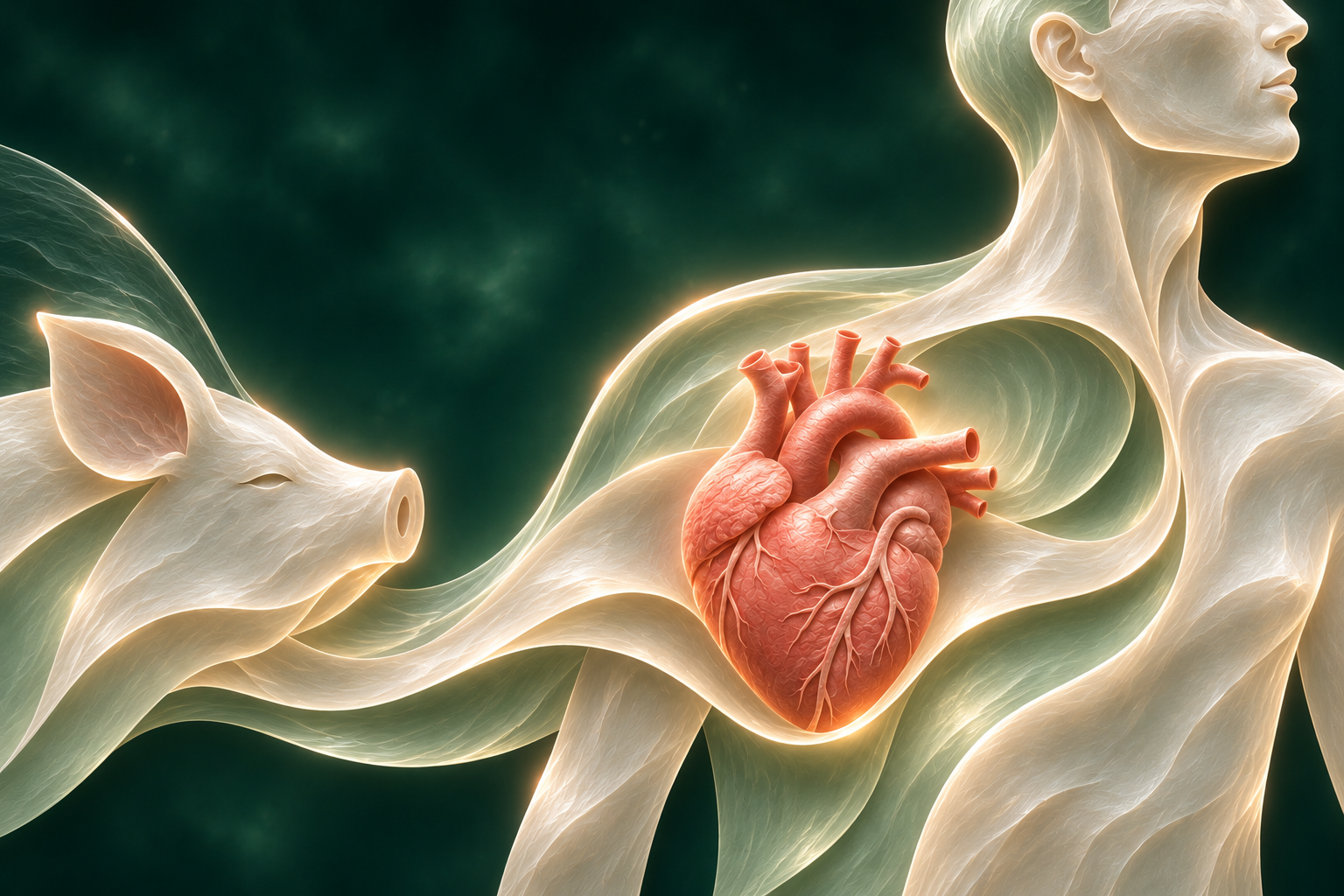
On 7 January 2022, surgeons transplant a pig’s heart into his chest. US regulators have granted special permission for the procedure in this critically ill patient. Known as compassionate use, this route allows an experimental treatment to be tried in particular circumstances.
Why look to another species for an organ?
A transplant replaces a diseased organ with one capable of doing its job. But the supply of human organs cannot meet demand. An animal donor could provide another source of organs. It has a name: xenotransplantation, meaning a transplant between two species.
The challenge goes beyond connecting blood vessels. Our immune system, the body’s defences, distinguishes what belongs to us from what is foreign. It can attack the cells of a transplanted organ: this is rejection. Making an organ from another species compatible with a human recipient is especially challenging.
A long history, a new approach
As early as the 1960s, teams were attempting to transplant chimpanzee kidneys into humans. In 1964, James Hardy transplanted a chimpanzee’s heart into a man; the heart beat for only about an hour and a half. In 1984, an infant known as Baby Fae received a baboon’s heart and survived for nearly three weeks.
David Bennett was therefore not the first human to receive an animal heart. What set his operation apart was the preparation of the donor pig: researchers had altered some of its genes to make its heart more compatible with a human body.
Ten changes before the transplant
Genes are stretches of DNA that help provide instructions for how cells work. In this pig, three genes were switched off to reduce the risk of rapid rejection. Six human genes were added to improve the organ’s compatibility. Another pig gene was switched off to limit its growth.
These ten changes do not turn a pig’s heart into a human heart. Their aim is to allow it to function in a human recipient. Medicines are also needed to dampen the body’s defensive reactions against the transplanted organ.
What the operation made possible
After the transplant, the heart works well enough for the team to remove the machine supporting his circulation. For several weeks, a pig’s heart keeps David Bennett’s blood flowing. He spends time with his family and begins rehabilitation.
His condition then deteriorates. He dies on 8 March 2022, sixty days after the operation, without having been able to return home. Analyses suggest several mechanisms behind the transplanted heart’s failure, including immune-related damage and a possible contribution from a pig virus. They do not identify a single cause; no evidence was found that the virus had infected human tissues.
What researchers learnt from the two cases
In September 2023, a second patient, Lawrence Faucette, receives a genetically modified pig’s heart. He survives for forty days. This new case provides further information, notably about how the recipient’s defences eventually attack the organ.
These first transplants showed that a genetically modified animal heart could sustain a human being’s circulation. The next step is to prolong that function and enable patients to return to life outside hospital. Behind the surgical achievement lies a very practical ambition: one day, to have more organs available for those who need them.
Further reading
Medical report on David Bennett’s transplant, NEJM, 2022
Genetic preparation of the donor, University of Maryland, January 2022
History of James Hardy’s heart transplant, the centre that performed the operation
Share this article
