
In this article
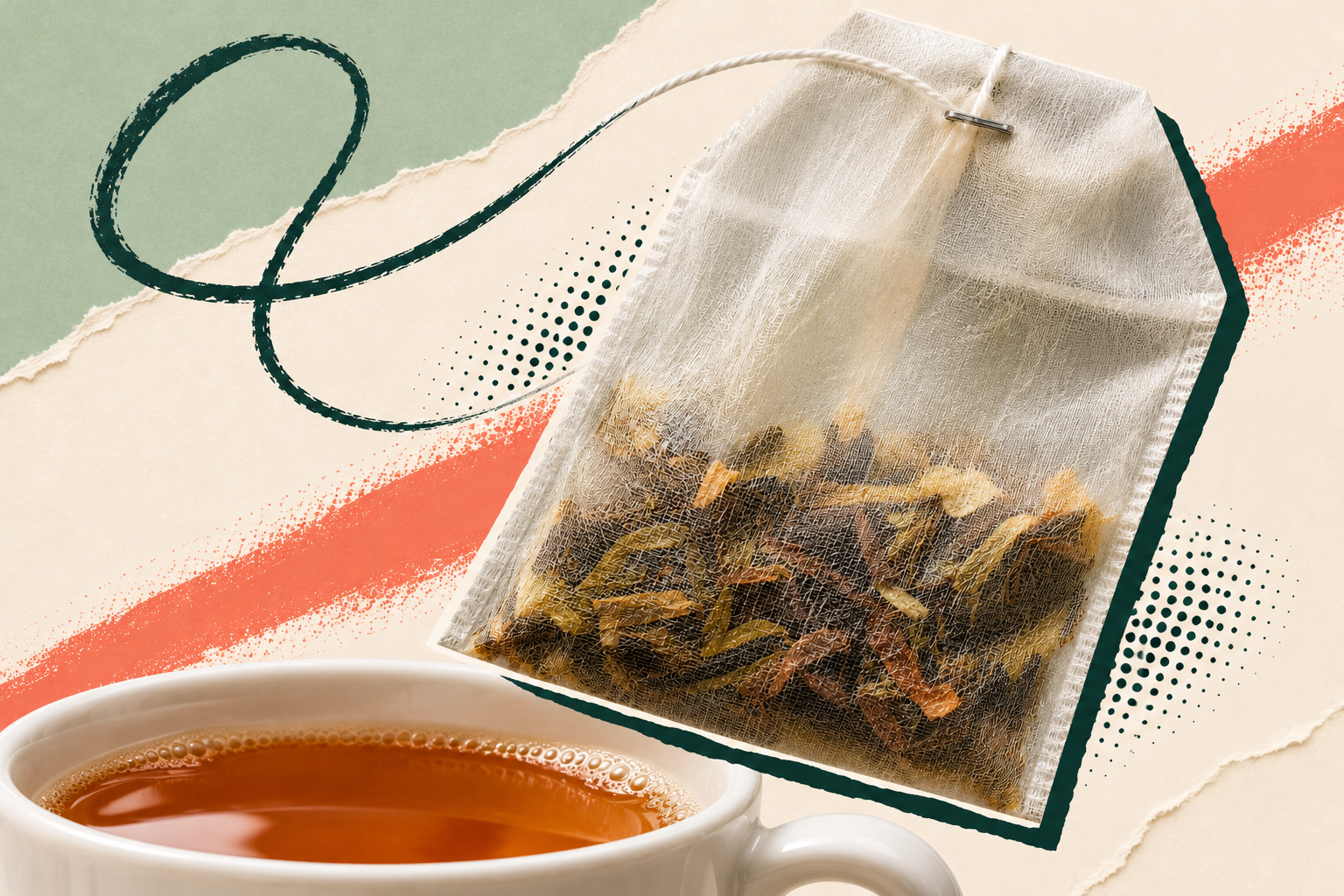
Some teabags are made entirely of plastic, including nylon. Others mix cellulose fibres with plastic. Plastic-free teabags also exist: their composition needs checking, because a paper-like appearance is not enough to identify them.
Another subtlety: ‘plant-based’ does not mean ‘plastic-free’. PLA is a plastic that can be made from plant resources. A study observed the release of particles from PLA teabags under its experimental conditions.
What can a teabag release?
Some teabags contain plastic. Microplastics are very small particles of this material; nanoplastics are even smaller. To give a sense of scale, a micrometre is one thousandth of a millimetre. Such particles can be too small to see with the naked eye, even when the tea looks perfectly clear.
Researchers need to answer several questions: how many are there, how big are they and what are they made of? Counting the dots visible in a microscope image is not enough to establish that each one is plastic. And two techniques that detect different sizes can produce very different results.
Billions, really?
In 2019, a Canadian team studied plastic teabags immersed in hot water. The researchers estimated that each bag released billions of particles under their test conditions. This striking figure circulated widely. Yet it concerned specific materials prepared for an experiment, rather than all teabags sold in shops.
Germany’s risk assessment institute challenged the counting method. The water had been evaporated before observation. But dissolved substances can form deposits as they dry. These deposits might then be mistaken for particles that were already present in the water. Imagine a drop of salt water drying: what remains on the surface did not necessarily have the same form in the drop.
In its own investigations, the institute found far fewer particles larger than one micrometre. The disagreement is partly about what the methods actually measure. The largest headline number does not necessarily give the clearest picture of what is in a cup of tea.
Why study intestinal cells?
Another team examined three teabag materials: nylon, polypropylene and cellulose. The first two are plastics; cellulose is a reminder that not everything released from a teabag is necessarily plastic. The researchers then exposed human intestinal cells grown in the laboratory to the extracts.
They observed particles entering some cells. This experiment helps explain how materials interact with living systems. But the cells were directly exposed in a laboratory setup: the experiment did not involve people drinking tea. The observation therefore does not demonstrate that these teabags cause disease in people who use them.
This distinction is essential for following the research. Detecting particles, observing their contact with cells and establishing an effect on human health are three separate steps. The first can be studied before the answers to the other two are known.
Can we avoid plastic?
Yes. Loose-leaf tea and a stainless-steel infuser are a simple option. If you prefer teabags, you can look for an explicitly plastic-free composition, including the seal. The words ‘plant-based’ or ‘biodegradable’ are not enough to guarantee this.
Cotton or cellulose filters are also options, provided their full composition is checked.
These choices remove the teabag as a source of plastic. They do not guarantee a drink containing no particles at all, and the studies consulted have not demonstrated a health benefit to date.
Further reading
- Hernandez et al., Environmental Science & Technology, 2019
- BfR, communication 029/2025 of 5 August 2025
- Banaei et al., Chemosphere, DOI 10.1016/j.chemosphere.2024.143736
- The release of polylactic acid nanoplastics from commercial teabags, 2023
- PLA2023 article, Plasticheal project version
- Spectral imaging for characterization and detection of plastic substances in branded teabags, Journal of Hazardous Materials, 2021
Share this article
