
Doctors and AI: putting the partnership to the test
In this article
A mammogram to examine, an electrocardiogram to interpret, a diagnosis to clarify: much of medical work involves making sense of information. This is where artificial intelligence is finding some of its most practical applications today. It looks for features in an image or a signal that it has learnt from many examples.
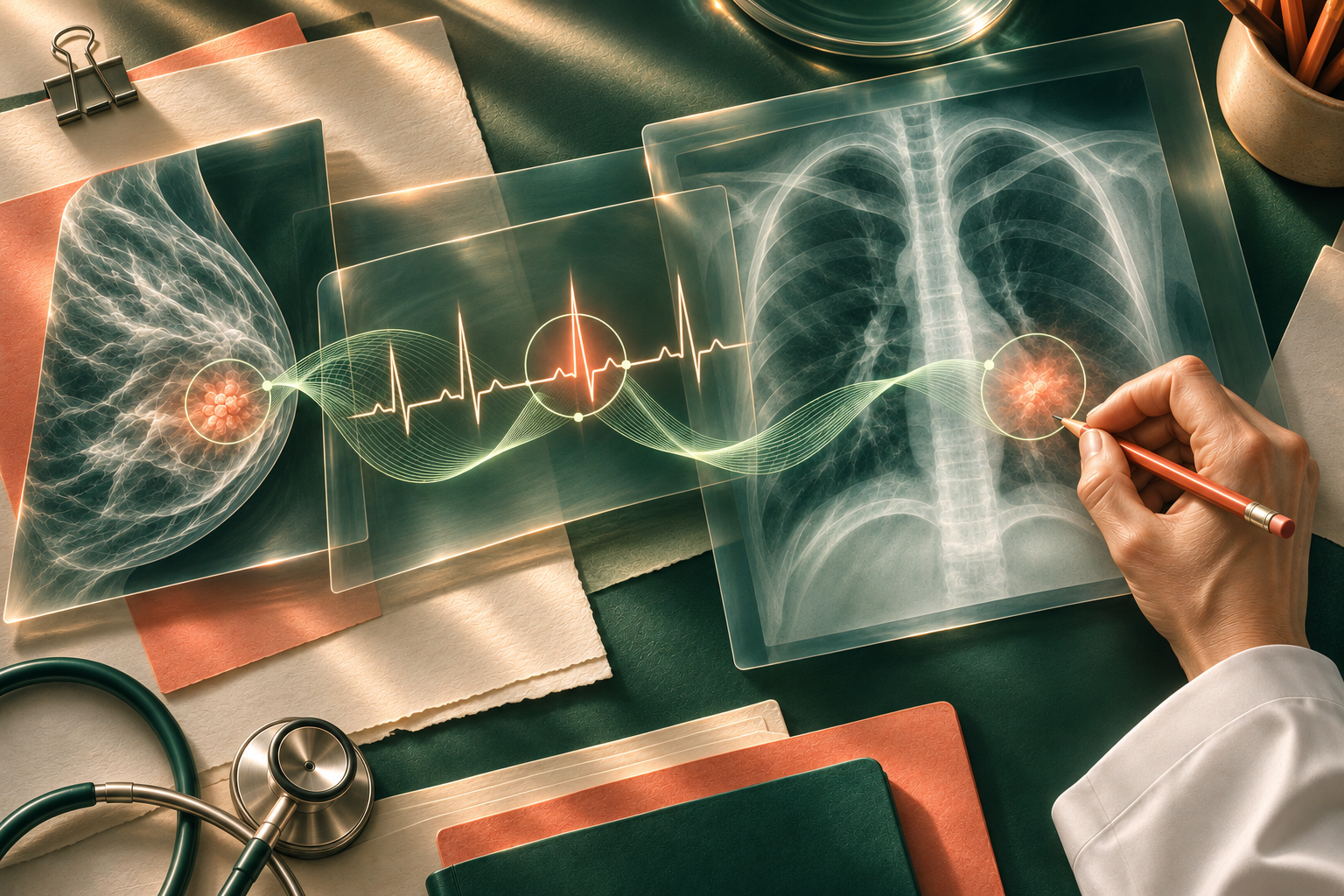
But getting a test question right is different from helping a team care for patients. To discover what actually changes, let us follow three situations: breast cancer screening, a patient’s arrival in the emergency department and the search for the cause of breathing difficulties.
Another pair of eyes on mammograms
A mammogram is an X-ray of the breasts. In screening, it is used to look for signs of cancer before symptoms appear. In Sweden, researchers compared the usual assessment by two radiologists with a system in which AI helps doctors and routes mammograms for review by one or two radiologists.
More than 105,000 women were randomly assigned to these two systems. The results published in 2026 are encouraging: AI-assisted screening detected a higher proportion of cancers while maintaining a comparable ability to identify examinations without cancer. It also reduced the radiologists’ reading workload.
The researchers also counted cancers discovered between screening appointments. The rate stayed within the study’s predefined limit for judging the AI-assisted system acceptably safe compared with standard screening. However, the difference observed did not establish that it reduced these cancers. The advance is therefore a better way of organising screening, without evidence at this stage of an effect on life expectancy.
An alert that saves time in the emergency department
In some heart attacks, an artery supplying the heart is blocked. A procedure called angioplasty can reopen it. First, though, the problem must be recognised quickly, the right team alerted and care organised.
In Taiwan, researchers tested a system that analysed the electrocardiogram, the recording of the heart’s electrical activity. When it detected the signs it was looking for, it sent an alert to the cardiologist, who retained responsibility for the medical decision.
Among the patients included in the comparison of time to intervention, 67 received care with the system’s help and 65 were in the usual-care group. The median time from arrival to the procedure was 82 minutes with AI and 96 minutes with usual care. In each group, half the patients waited less than the median and half waited longer.
The software was therefore not treating anyone on its own. Its value lay in getting useful information to the right people faster. This illustrates a form of innovation that may look unremarkable on a screen but makes a tangible difference to how emergency care is organised. The study does not, however, establish a survival benefit.
Learning to spot the tool’s mistakes too
A third study asked a practical question: do AI suggestions help healthcare professionals make more accurate diagnoses? Researchers compared the proportion of correct answers without assistance, with standard AI and with deliberately biased AI.
They also examined treatment choices, but did not measure patients’ recovery or survival.
The researchers presented 457 healthcare professionals with case files containing symptoms, test results and X-rays from patients with severe breathing difficulties. They had to identify the disease responsible, first without help and then with AI suggestions.
To test the effects of misleading advice, the researchers deliberately introduced systematic errors: for example, one version suggested pneumonia whenever a patient was aged 80 or over. With standard AI, participants found the correct diagnosis more often. With the biased versions, their answers became less accurate.
Some participants also saw highlighted areas of the X-ray intended to explain the AI’s answer. This display was not enough to prevent the errors caused by its poor suggestions. In this experiment, showing an explanation therefore did not guarantee a better decision. These were exercises, with no changes to patient care.
Making the partnership work
These three examples tell the story of a gradual evolution. AI can provide another pair of eyes on an image or speed up an alert. Its usefulness also depends on how a team receives and uses the information. The value comes from how well a tool fits the work clinicians actually do.
Sources
Breast cancer screening: Swedish trial, The Lancet, 2026
Share this article
