
In this article
Copper is essential to our health. We take in small amounts when we eat, and our bodies must then remove what they no longer need. In Wilson’s disease, this mechanism is disrupted: copper builds up, particularly in the liver, and can eventually damage several organs, including the brain.
What if the genetic instruction behind the problem could be repaired? That is the aim of an experimental treatment given to a first patient, whose story Nature reported on 22 October 2026. The new step is to deliver prime editing, a technique developed from CRISPR, directly into the body.
When a genetic change disrupts copper handling
To understand the approach, imagine DNA as a vast set of instructions. Every cell keeps a copy. A gene is a section of that set which contains, among other things, the directions needed to make a protein, a molecule with a task to perform.
In Wilson’s disease, the gene involved is called ATP7B. The protein it makes helps remove copper from the liver. Certain changes in this gene, called mutations, prevent the protein from working properly. The problem is therefore not simply having eaten too much copper: the body’s ability to handle it is impaired.
Current treatments remove excess copper or limit its absorption by the intestine. They can prevent complications or improve symptoms, but generally need to continue for life. In some severe forms, a liver transplant may be necessary.
From scissors to a text editor
CRISPR is often described as a pair of molecular scissors. The image fits conventional tools quite well: they locate a DNA sequence and cut it, then the cell repairs the break. This strategy can be used, among other things, to switch off a gene.
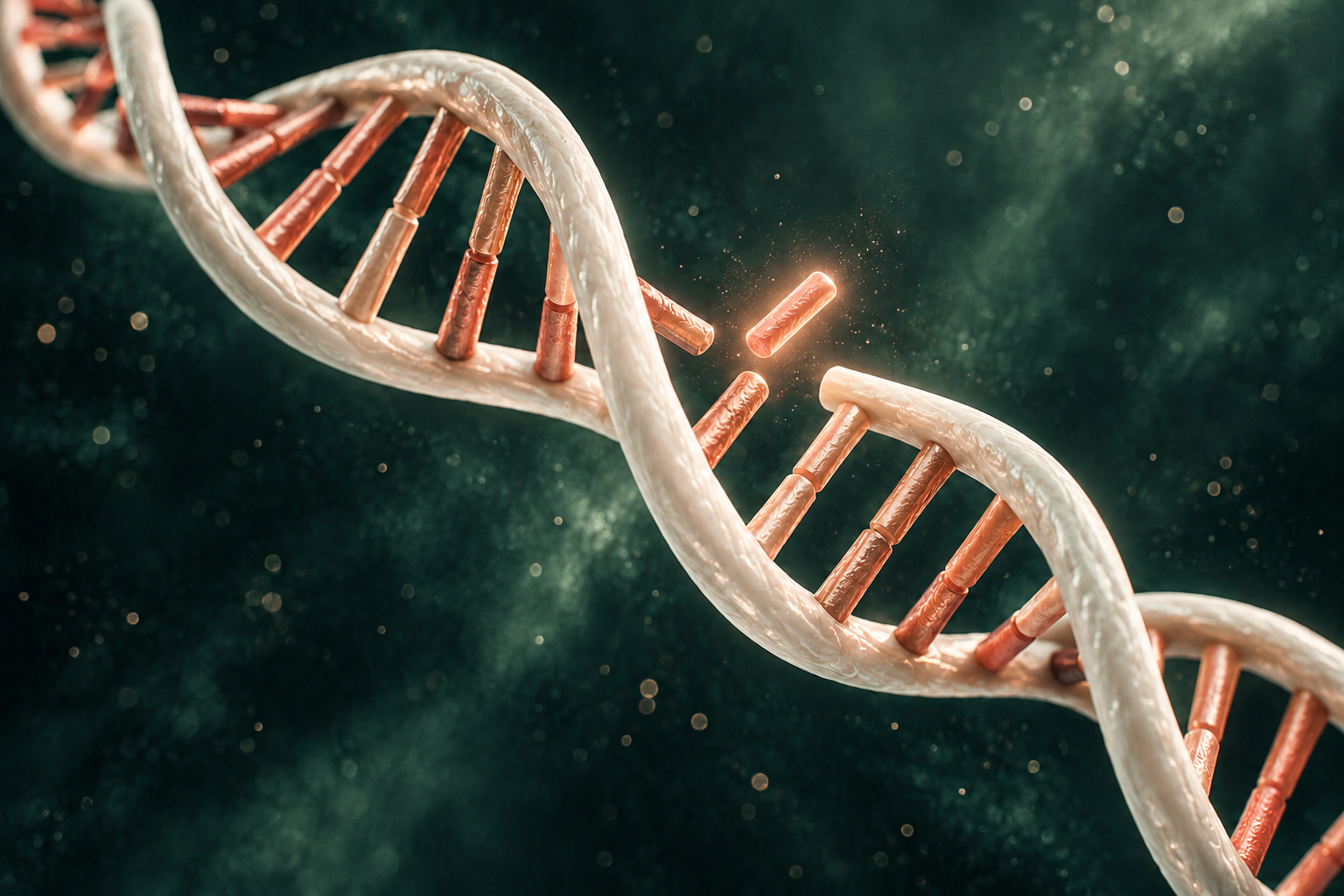
Prime editing, introduced in 2019, is more like a ‘find and replace’ function. A molecular guide identifies the target location and carries the instructions for the desired correction. The editing machinery then writes the new sequence. Depending on the intended outcome, the technique can replace DNA letters, add them or remove them.
It does not need to cut both strands of the double helix at the same time, as conventional CRISPR does. This broadens the range of possible changes. But the word-processing metaphor has a limit: a cell is not a computer document. Researchers need to check that correction happens often enough, in the right place, without unwanted changes.
Delivering the editing tools to the liver
Some gene therapies require cells to be collected, modified in a laboratory and then returned to the patient. Here, the cells stay where they are. The treatment is designed to bring the editing tools to the liver through an infusion into a vein.
Tiny envelopes made of lipids, fatty molecules, carry this material. Their role is to deliver it to the target cells. This is what ‘in vivo’ means: the genetic intervention is intended to take place inside the body, rather than in cells removed from it. The aim is not to change all of the patient’s DNA, but to target a specific abnormality in the relevant cells.
What comes next
Prime Medicine announced this first administration on 5 October 2026. Its treatment, PM577a, targets a particular mutation that causes Wilson’s disease, so it is not designed for everyone who has the condition.
The trial must first establish how well the treatment is tolerated and look for its initial effects. Researchers will examine, among other things, whether the body handles copper better. The first clinical data are expected in 2027.
The patient has received the treatment. Whether it successfully edits the target DNA and improves their health is still to be established. It is nevertheless an important step: a tool developed to rewrite DNA is entering a trial in which it is meant to act directly inside the body. The next question will be very concrete: can this correction make a lasting difference to the life of someone with the disease?
Sources and background
- Nature, Heidi Ledford, 22 October 2026. News article about this first administration
- Prime Medicine, 5 October 2026. Announcement by the clinical trial sponsor, not a publication of efficacy results
- Anzalone and colleagues, Nature, 2019. Scientific introduction to prime editing
- NIDDK, NIH. Understanding Wilson’s disease
- NIDDK, NIH. Treatments for Wilson’s disease
Share this article
